Checking tire pressure is one of the simplest car maintenance jobs you can do yourself. It takes only a few minutes, requires an inexpensive gauge, and can help your tires wear properly while supporting safe handling and fuel efficiency.
If you are wondering how to check tire pressure, the basic process is simple: find your vehicle’s recommended PSI, check the tires when they are cold, press a tire pressure gauge firmly onto each valve stem, compare the reading with the recommended pressure, then add or release air as necessary.
The important part is knowing which pressure number to use and when to take the measurement.
Quick Answer: How Do You Check Tire Pressure?
Follow these six steps:
- Park the vehicle and allow the tires to cool.
- Find the recommended PSI on the driver’s door jamb label or in the owner’s manual.
- Remove the valve stem cap from one tire.
- Press your tire pressure gauge firmly onto the valve stem.
- Read the PSI and compare it with the vehicle recommendation.
- Add air if the reading is low, or carefully release some air if it is too high.
Repeat the process for every tire and check the spare if your vehicle has one.
NHTSA recommends checking tire pressure at least once a month and before longer trips.
You can find more vehicle maintenance content in MediaSubmit’s Auto Mobile category.
What Does PSI Mean?
PSI stands for pounds per square inch. It is the measurement commonly used in the United States to describe tire inflation pressure.
For example, your vehicle might specify:
Front tires: 35 PSI
Rear tires: 33 PSI
Those numbers are only examples. Do not assume that 32, 35, or any other common number is correct for your car.
Your vehicle manufacturer determines the recommended pressure according to the vehicle, tires, load requirements, and other engineering factors.
Step 1: Find the Correct Tire Pressure
Before touching the tire gauge, find the correct PSI for your vehicle.
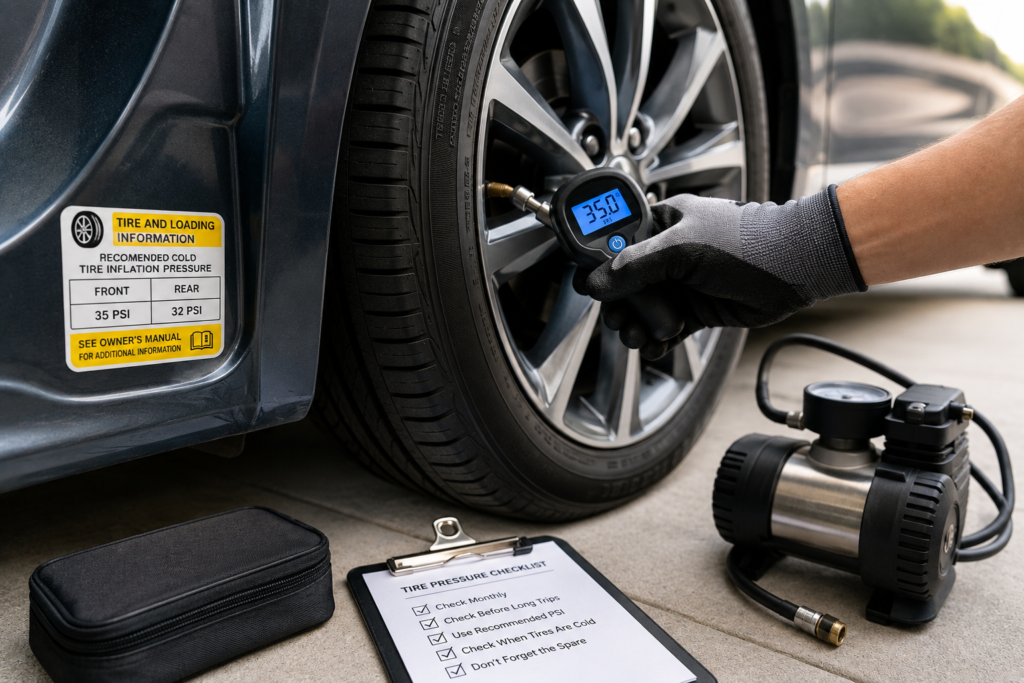
Look for the Tire and Loading Information label, usually located on the driver’s side door jamb or door frame. You can also check your owner’s manual.
NHTSA specifically advises using the pressure specified by the vehicle manufacturer, not the number molded onto the tire itself.
This distinction is important.
Do Not Use the Maximum PSI on the Tire Sidewall
A tire sidewall may display a pressure number, but this should not automatically be used as your everyday inflation target.
The correct operating pressure comes from your vehicle’s placard or owner’s manual.
Also check whether the manufacturer specifies different pressures for the front and rear tires. Bridgestone recommends recording both numbers before checking the tires so they are not accidentally confused.
Step 2: Check the Tires When They Are Cold
For the most accurate comparison with the manufacturer’s recommended pressure, check the tires when they are cold.
NHTSA describes cold tires as tires on a vehicle that has not been driven for at least three hours.
Driving generates heat. As the tire and the air inside it warm up, pressure can increase. That means checking immediately after a highway drive may give you a higher reading than the tire had before the trip.
A convenient habit is to check your tires in the morning before driving.
Do not deliberately release air from a hot tire simply because its reading is above the cold specification.
Step 3: Remove the Valve Stem Cap
Locate the small valve stem on the wheel.
Unscrew its cap and keep it somewhere safe. A pocket is better than putting it on the ground where it can easily disappear.
Take a quick look at the valve stem while you are there. If it appears cracked or damaged, have it inspected.
Step 4: Attach the Tire Pressure Gauge
Press the gauge firmly and straight onto the valve stem.
You may hear a quick hiss as the gauge connects. If air continues escaping, reposition the gauge until you have a proper seal.
Your reading depends on the gauge type.
Digital gauge
The PSI appears on a small electronic display.
Pencil gauge
A measuring stick slides outward from the gauge and displays the pressure.
Dial gauge
A needle moves across a numbered dial.
All three types can perform the basic job. The most important factors are using the gauge correctly and keeping it in good condition.
Michelin’s current guidance follows the same basic process: connect the gauge to the valve stem, read the PSI, and compare the result with the recommended pressure.
Step 5: Compare the Reading With the Recommended PSI
Suppose your vehicle placard says 34 PSI and your gauge reads 30 PSI.
The tire needs additional air.
If the recommended pressure is 34 PSI and the gauge reads 38 PSI while the tire is genuinely cold, some air may need to be released.
Make adjustments gradually, then measure again.
Do not simply inflate all four tires to the same number without checking the placard. Some vehicles require different front and rear pressures.
Step 6: Add Air if the Tire Pressure Is Low
If a tire is underinflated, connect an air compressor to the valve stem.
You can use a portable compressor at home or an air station.
Add a small amount of air, disconnect the compressor, then measure again with your gauge.
Repeat until you reach the manufacturer’s recommended cold PSI.
After finishing, replace the valve cap.
Then repeat the complete process for the remaining tires.
How Often Should You Check Tire Pressure?
A good routine for most drivers is at least once a month.
You should also check before a long road trip and whenever you suspect that a tire is losing pressure.
NHTSA recommends checking all tires, including the spare, at least monthly while they are cold.
Monthly checking matters even if your vehicle has a Tire Pressure Monitoring System.
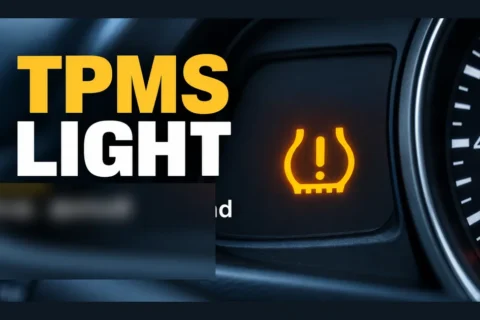
Can You Rely on the TPMS Light?
No.
TPMS is a useful warning system, but it should not replace regular manual checks with a gauge.
Federal TPMS requirements are designed around warning drivers when pressure becomes significantly low. NHTSA’s standard includes a warning threshold based around tires reaching 25 percent or more below the vehicle manufacturer’s recommended cold inflation pressure under specified conditions.
That means a tire can be below its ideal pressure before the warning light appears.
Check pressure yourself rather than waiting for the dashboard light.
Does Weather Change Tire Pressure?
Yes.
Air pressure changes with temperature, which is why drivers often notice the TPMS light after colder weather arrives.
Michelin recommends checking tire pressure more frequently during cold weather and always using the manufacturer’s cold tire specification.
Do not permanently lower your tire pressure simply because the weather becomes hot, and do not inflate according to a random seasonal PSI recommendation found online.
Continue using the specification supplied for your vehicle.
What If One Tire Keeps Losing Pressure?
A tire that repeatedly loses pressure needs investigation.
Possible causes include:
- A puncture
- A leaking valve
- Wheel or rim problems
- Tire damage
- Another slow leak
Adding air repeatedly is not a repair.
If one tire drops noticeably faster than the others, have the tire inspected by a qualified professional.
Similarly, a tire with a visible bulge, significant cut, exposed material, or other obvious damage should be professionally inspected instead of simply reinflated.
Do You Need to Check the Spare Tire?
Yes, if your vehicle has an inflatable spare.
A spare that has been sitting unused can still lose pressure over time. Discovering that it is underinflated only after another tire goes flat defeats the purpose of having it.
Check the spare according to the pressure specification provided for that tire and vehicle.
NHTSA specifically includes spare tires in its pressure checking guidance.
Tire Pressure and Tire Rotation Work Together
Correct pressure does not replace other tire maintenance.
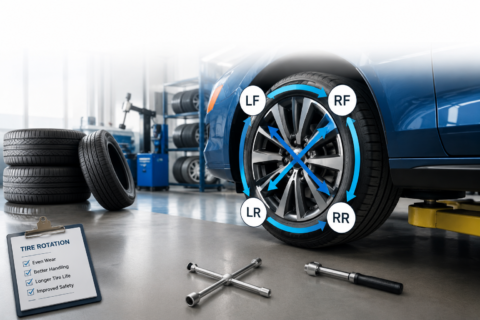
Tires also need regular inspection for tread wear, damage, and uneven wear. Rotation may help distribute normal wear between tire positions when your vehicle and tire configuration allow it.
If you are building a simple maintenance routine, check tire pressure monthly and follow your manufacturer’s rotation schedule.
MediaSubmit also has automotive and engine maintenance information in its existing guide to Kohler Engines.
For authoritative tire safety information, you can also review the official NHTSA TireWise tire safety guide.
Common Tire Pressure Mistakes to Avoid
Using the sidewall pressure as your target
Use the vehicle manufacturer’s recommended PSI instead.
Checking immediately after driving
Warm tires can give a higher reading than cold tires.
Checking only when the TPMS light appears
Manual monthly checks can identify pressure changes earlier.
Forgetting the rear tires
Check every tire individually.
Assuming front and rear PSI are identical
Some vehicles specify different pressures.
Forgetting the spare
A spare also needs enough pressure to work when required.
Adding air without rechecking
Measure again after adjusting the pressure.
Frequently Asked Questions
How do you check tire pressure without a gauge?
A visual inspection cannot reliably tell you the exact PSI. Use a proper tire pressure gauge or have the pressure measured professionally.
Should the car be running when checking tire pressure?
No. The engine does not need to be running. The important condition is that the tires are cold for the best comparison with the manufacturer’s cold PSI specification.
Where do I find the correct PSI for my car?
Check the driver’s door jamb tire placard or the owner’s manual. Do not automatically use the maximum pressure printed on the tire.
How often should tire pressure be checked?
NHTSA recommends checking at least once a month and before longer trips.
Should I check all four tires?
Yes. Check every road tire and the spare if your vehicle has one.
What should I do if the TPMS light is on?
Safely check the tire pressures with a gauge and compare them with your vehicle manufacturer’s specifications. If pressure continues dropping or the warning remains after the tires are correctly inflated, the tire or TPMS system may need professional attention.
Conclusion
Learning how to check tire pressure takes only a few minutes.
Find the recommended PSI on your vehicle’s door jamb or owner’s manual, check the tires when they are cold, use a reliable gauge, and adjust each tire to the manufacturer’s specification.
Do this at least monthly, check before long trips, and do not wait for the TPMS warning light.
The most important rule is also the easiest to remember:
Use your vehicle’s recommended PSI, not the maximum pressure printed on the tire.
For more practical automotive and everyday guides, visit MediaSubmit.